
In most businesses, there is an uncomfortable truth: most of us make a start on new projects too late. That’s not a criticism – it’s a common pattern we see often enough to recognise. Does it mean the opportunity has passed? No, most of the time. But like a lot of strategic decisions, localisation tends to get picked up long after it should. The team is busy, your priorities compete, and markets that feel distant have a way of suddenly feeling very close.
The best time to start the conversation is long before you need it, but you probably already know that.
1. What “Website Localisation” Actually Means for Your Business
If you haven’t done this before, you probably think of localisation more as a translation process than anything else. To some extent, you are right. Translation changes the words, it’s true. However, localisation changes the experience – it’s the work of adapting your entire digital presence so it functions, and feels right, to users in a new market.
Local tools for local markets
For China especially, but also East Asia, localisation means you need to replace the Western tools that simply don’t work behind the Great Firewall. Think Google Analytics, Facebook pixels, YouTube, and countless others you rely on without even thinking about it. It means securing an ICP licence to legally host content in China. It also means you need to make sure your content sits on infrastructure your target audience can actually reach. Is this your first time navigating that? Expect neither process to be smooth or fast, but it’s not all bad news.
Branding for your new market
You also need to think carefully about how your brand comes across. The imagery you use, the tone you write in, the layout conventions your audience expects – all of these vary significantly from market to market. Does a site that’s been genuinely localised feel like a translation to the people using it? It really shouldn’t. It should feel like it was built with them in mind – and they shouldn’t even be able to notice that the true origin of this content wasn’t from their own culture.
2. Who Needs This and When
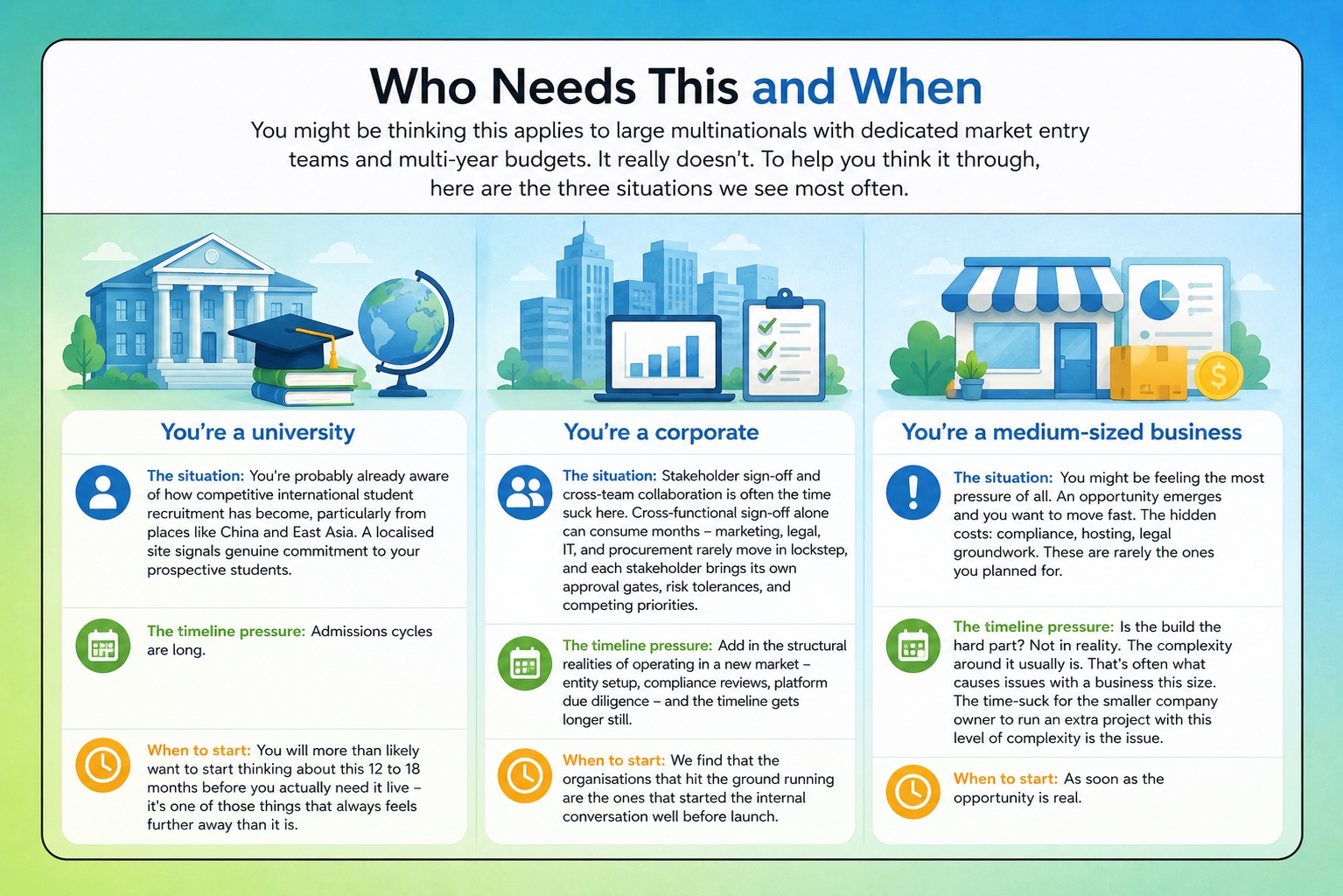
You might be thinking this applies to large multinationals with dedicated market entry teams and multi-year budgets. It really doesn’t. To help you think it through, here are the three situations we see most often.
You’re a university
The situation: You’re probably already aware of how competitive international student recruitment has become, particularly from places like China and East Asia. A localised site signals genuine commitment to your prospective students.
The timeline pressure: Admissions cycles are long.
When to start: You will more than likely want to start thinking about this 12 to 18 months before you actually need it live – it’s one of those things that always feels further away than it is.
You’re a corporate
The situation: Stakeholder sign-off and cross-team collaboration is often the time suck here. Cross-functional sign-off alone can consume months – marketing, legal, IT, and procurement rarely move in lockstep, and each stakeholder brings its own approval gates, risk tolerances, and competing priorities.
The timeline pressure: Add in the structural realities of operating in a new market – entity setup, compliance reviews, platform due diligence – and the timeline gets longer still.
When to start: We find that the organisations that hit the ground running are the ones that started the internal conversation well before launch.
You’re a medium-sized business
The situation: You might be feeling the most pressure of all. An opportunity emerges and you want to move fast. The hidden costs: compliance, hosting, legal groundwork. These are rarely the ones you planned for.
The timeline pressure: Is the build the hard part? Not in reality. The complexity around it usually is. That’s often what causes issues with a business this size. The time-suck for the smaller company owner to run an extra project with this level of complexity is the issue.
When to start: As soon as the opportunity is real.
3. What It Actually Costs and When It Makes Sense
Costs vary more than you might expect – a bit like asking how much a website costs. It depends on what you need. Your site’s complexity, the number of pages, your existing integrations, and what compliance looks like for your specific situation all play a part. There’s no single number that fits everyone. But it helps to understand what’s actually driving the cost.
| Cost driver | What to know |
| ICP licence (non-commercial) | Typically takes two to eight weeks to file |
| ICP licence (commercial) | Takes considerably longer |
| China-based hosting | Sites hosted outside mainland China can appear broken or fail to load entirely |
| Western tool replacement | Google Analytics, YouTube embeds, Google Fonts – all need local equivalents: WeChat, Baidu, local CDNs |
| Ongoing maintenance | Keeping both versions of your site in sync as your content evolves |
Does the investment make sense for you? That really depends on what the market represents commercially. One study found that companies investing in localisation saw an average return of 300%. A separate study found a 52% increase in international sales following website localisation.
For a corporate, the question is whether the new market represents a meaningful share of your growth targets. For a university, whether international student revenue from the region justifies the spend. For an SMB, whether a single contract or partnership would cover the cost. You may want to run those numbers before assuming the answer either way.
4. How Much Work Is This for Your Team?
This is probably the question you’re least likely to ask upfront – and the one that catches most organisations off guard. Localisation isn’t really an IT project, even if it feels like one. It touches marketing, legal, compliance, and leadership, often all at once.
Your team will likely need to be involved in content sign-off and brand governance. There are legal entity requirements for ICP compliance that don’t sit neatly with any single department.
Once you’re live, keeping both versions of your site in sync requires ongoing input that’s easy to underestimate. Is your team set up to absorb that on top of everything else? For most organisations, honestly, it isn’t. That’s where projects stall. Not budget. Bandwidth.
5. How Long Do These Projects Actually Take?
At Synclone we deliver these projects on a regular basis. We have extensive experience in localising websites mostly for the Chinese market for over 20 years as Eggplant Digital. This also included dealing with other marketing channels as well as wider consultancy on selling in local markets.
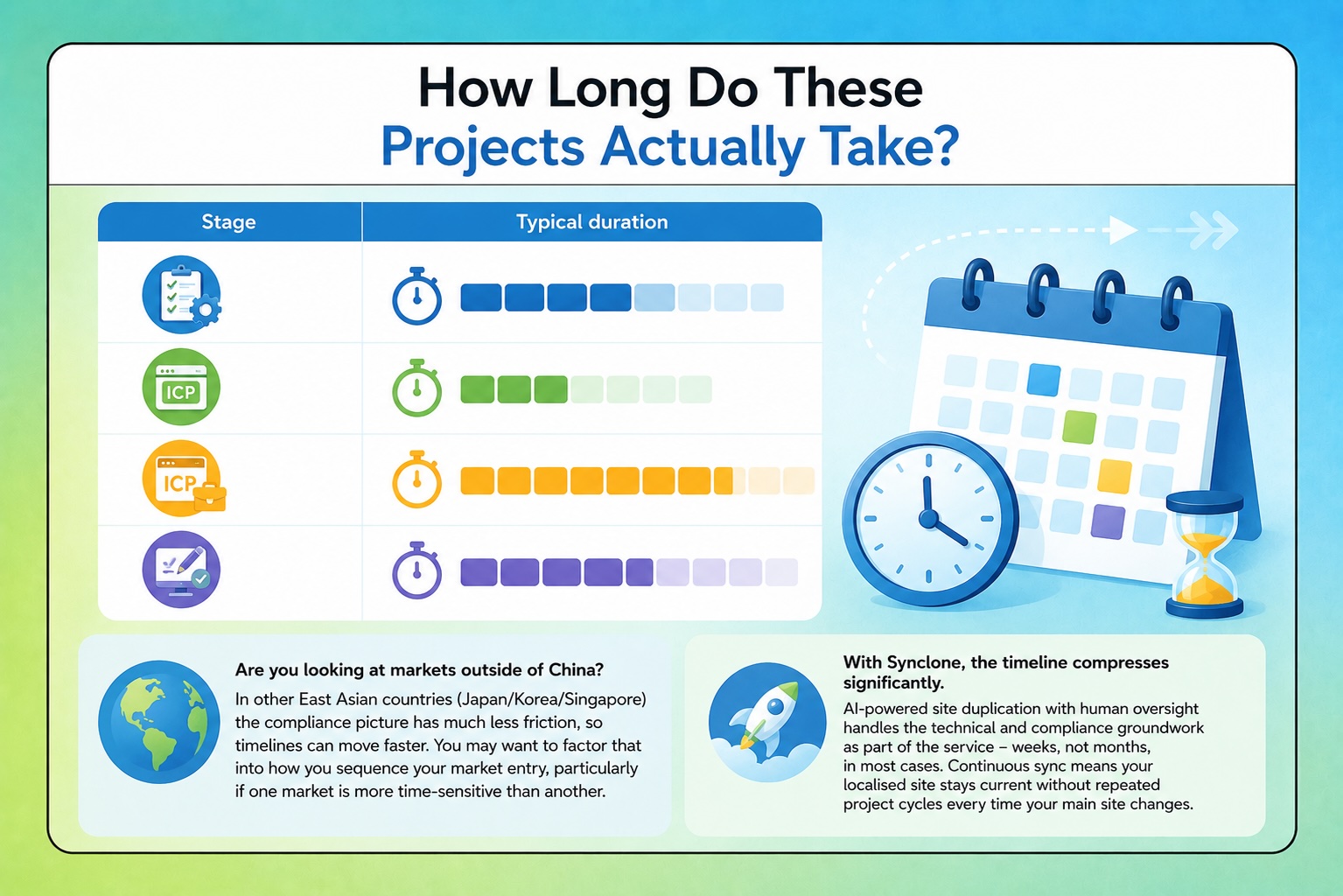
| Stage | Typical duration |
| Traditional localisation (minimum) | Three to six months, before procurement, legal, and IT get involved |
| ICP filing (non-commercial) | Four to eight weeks |
| ICP filing (commercial) | Considerably longer |
| Content adaptation, design, QA, soft launch | Adds further time on top |
Are you looking at markets outside of China? In other East Asian countries (Japan/Korea/Singapore) the compliance picture has much less friction, so timelines can move faster. You may want to factor that into how you sequence your market entry, particularly if one market is more time-sensitive than another.
With Synclone, the timeline compresses significantly. AI-powered site duplication with human oversight handles the technical and compliance groundwork as part of the service – weeks, not months, in most cases. Continuous sync means your localised site stays current without repeated project cycles every time your main site changes.
6. Should I Just Start Internally?
Whether you’re 18 months from a target launch or just starting to explore what entry into foreign markets might look like, you don’t need to have everything figured out before you start working on this internally.
If you want a clearer picture of a timeframe for a particular project, then contact us when you feel the time is right.
Comments (0)