
Once your company has decided to expand into different markets, it is time to address the issue of website localisation in order to grow your business. While this process may seem fairly simple, there are quite a few obstacles that your team needs to overcome.
There are also best practice and maintenance decisions to make along the way. The most important part, is that the localisation process is essentially two things – a set up, followed by an ongoing set of updates.
The traditional process for website localisation

Define your comprehensive strategy
So what’s the most common mistake here? A lack of a clear and comprehensive strategy.
You need a solid roadmap to adapt your site. This means you need to be sure about formats, messaging, and content facing new regions without diluting the brand.
Choose the right countries
Decide which countries you should target and how your brand voice should translate into the local languages of your new markets.
Keep a good eye on what success looks like via KPIs for your newly localised markets.
We recommend some solid research on cultural differences, purchasing behaviors, and local payment preferences (if needed) so you’re not left scrambling when you need to deal with sales and terms for new clients.
Design pages with localization in mind
Website design needs localisation, not just the copy, because layouts that work in one language often break in another. The old approach—design in one language and translate later, usually increases costs and slows down over time. Why? New pages introduce more opportunities for errors and bugs.
Plan early for text expansion and contraction. Some languages take significantly more or less space than English. Make sure your design system can handle non-Latin scripts like Chinese and Japanese, including different character density and vertical expansion patterns. The new version needs to stay clean across languages rather than looking “just translated.”
Create a solid workflow
When you localise your website it is not only a project for the development team. It actually involves developers, product managers, copywriters, marketers, translators, and QA—so you need careful project management across departments in order to make this work.
Teams usually follow a continuous/agile model. Continuous localisation keeps global sites more consistent because new content gets translated as it’s created rather than being bundled into separate projects. Some CMS platforms support localisation integrations that reduce manual steps and avoid organisational chaos. The goal is a workflow that keeps translations in sync with site changes while delegating to the right people at the right time to push updates and translations effectively.
Translate your web pages
Once the site is ready for localisation, translation becomes the next hurdle. The quickest way to deal with this is to incorporate AI into your translation process and have some well established and marketing accurate translators on hand. They need to be ready to respond every time you update your web copy, or add something new to the site. Generally, you would expect to hire freelancers or separate agencies, unless you already have a dedicated team for your new markets.
Measure your website localisation quality and strategy
After translation, your work moves into testing and refinement to ensure the local experience actually works in-market. The most critical part is that updates are pushed quickly to respond to changes in your offers and terms – the more often you iterate on your current site, the more important this becomes.
High Level Tip: Localise in “Country Clusters”
One thing we have seen is that localisation works well in clusters of countries. For example, we frequently get contacted about creating websites for China. Next, clients often realise that it makes financial sense to add Korean, Japan, and possibly Singapore, due to the similarity of the challenges faced in those countries. These clusters form because the country cultures run on a shared base operating system. In addition, they are neighbouring countries who refer across borders, so marketing efforts can become accumulative in certain cases.
How to localise fast, without rebuilding
After years of creating websites for the Chinese market, we came up with Synclone. Synclone is a “software with a service” offering that can localise and deploy your site in new markets as a done for you service. No big project to manage or cross-team headaches. Let’s see how localisation could look…
How Synclone gets the job done
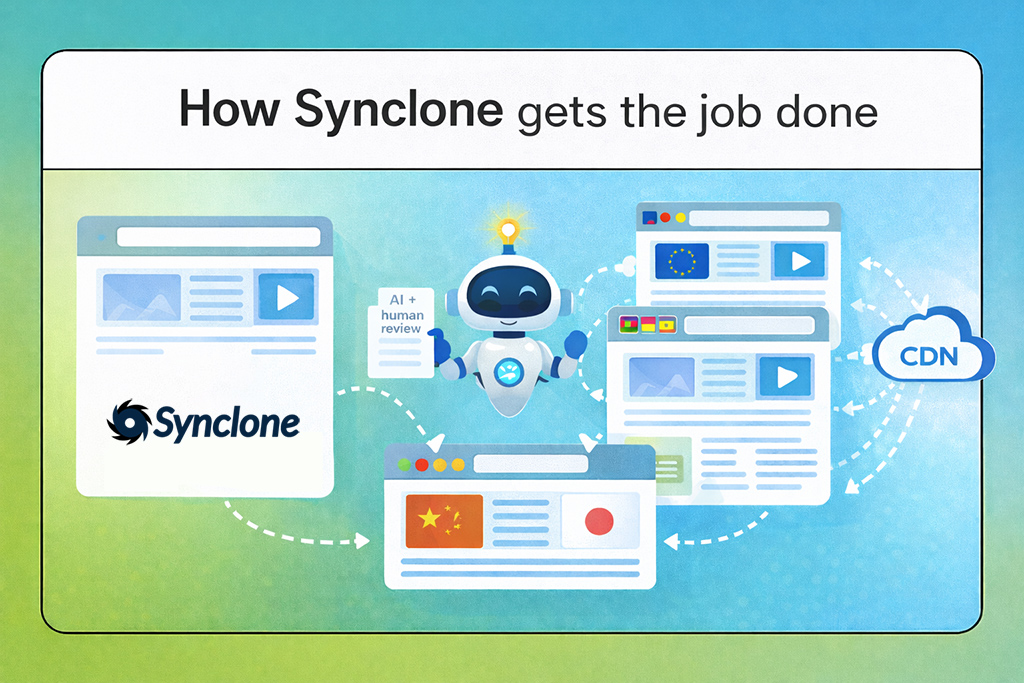
Synclone begins its process when it automatically replicates pages from your global website, with scheduled monthly syncs to keep everything consistent. Once pulled in, content passes through the platform’s localisation layer. This then combines AI-powered translation with human review. It edits your content to ensure accuracy and natural-sounding copy. Synclone then delivers via a high-speed CDN for optimal performance and reliability, with each language version served on its own local domain. This is important so that you maintain optimum performance in each individual market.
Synclone doesn’t need site access to function
Synclone doesn’t need a single username or password in order to complete the end to end localisation process. There is no need for access to the site, a URL is enough. The process is completely hands off for you and your team.
The practical benefits of Synclone compound quickly
Because synchronisation is handled automatically, your team reclaims hundreds of hours each year that would usually get sucked up by manual updates. All your translations are managed away from the global site in a centralised dashboard — you get notifications whenever new updates go live- this means you have no risk of localised versions drifting out of step with the original site. Brand consistency, informational accuracy, and alignment with the global site are all maintained without extra hours clocking up. This is truly a done-for-you service.
Synclone, security and your CMS
With Synclone we serve a static site through a CDN. This significantly reduces the risk of server issues and downtime. We eliminate the CMS layer and so remove an entire category of security vulnerabilities. For B2B organisations operating across multiple markets, that combination of reliability and reduced attack surface is more than a nice-to-have — it’s a meaningful operational advantage.
Who benefits from using Synclone?
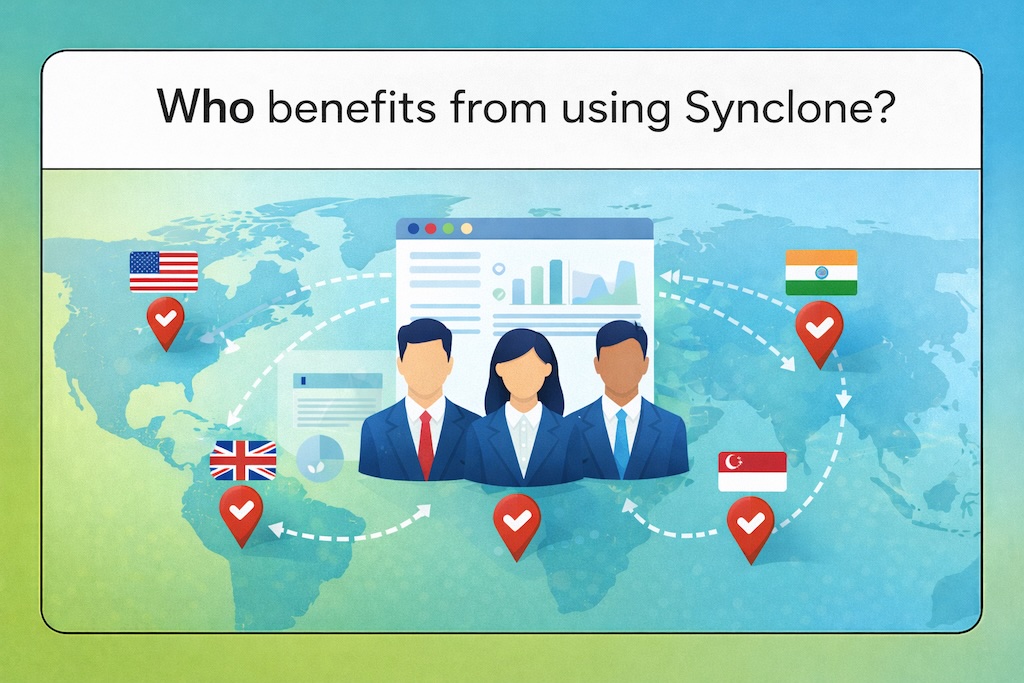
Synclone was originally developed for B2B enterprise clients- specifically, companies with an established presence in the USA or Europe that are now setting their sights on Asia. In truth, the solution is a website cloning localisation tool. Your organisation benefits from Syclone if you are running any site that needs to be localised for new markets.
If you are responsible for a website that needs localising, then Synclone is an option that deserves some further investigation.
The current client base is largely based in the US and UK, with growing interest from across Europe, Singapore, and India.
Does Synclone work with my CMS?
Right now we work with WordPress, Hubspot and Drupal. If you are using a different set up, please get in touch as we are taking on projects using other systems all the time.
How often does Synclone sync?
Synclone detects changes on your website and automatically updates your websites in the new markets. This process is continuous.
How Long Does The Synclone Process Take?
Obviously, there can be a bit of variation from project to project, but “weeks not months” is usually our timeline once everything is cleanly in place. Synclone isn’t a fit for everyone, but a powerful tool when the time is right.
Comments (0)